Post 5# – New emerging technologies
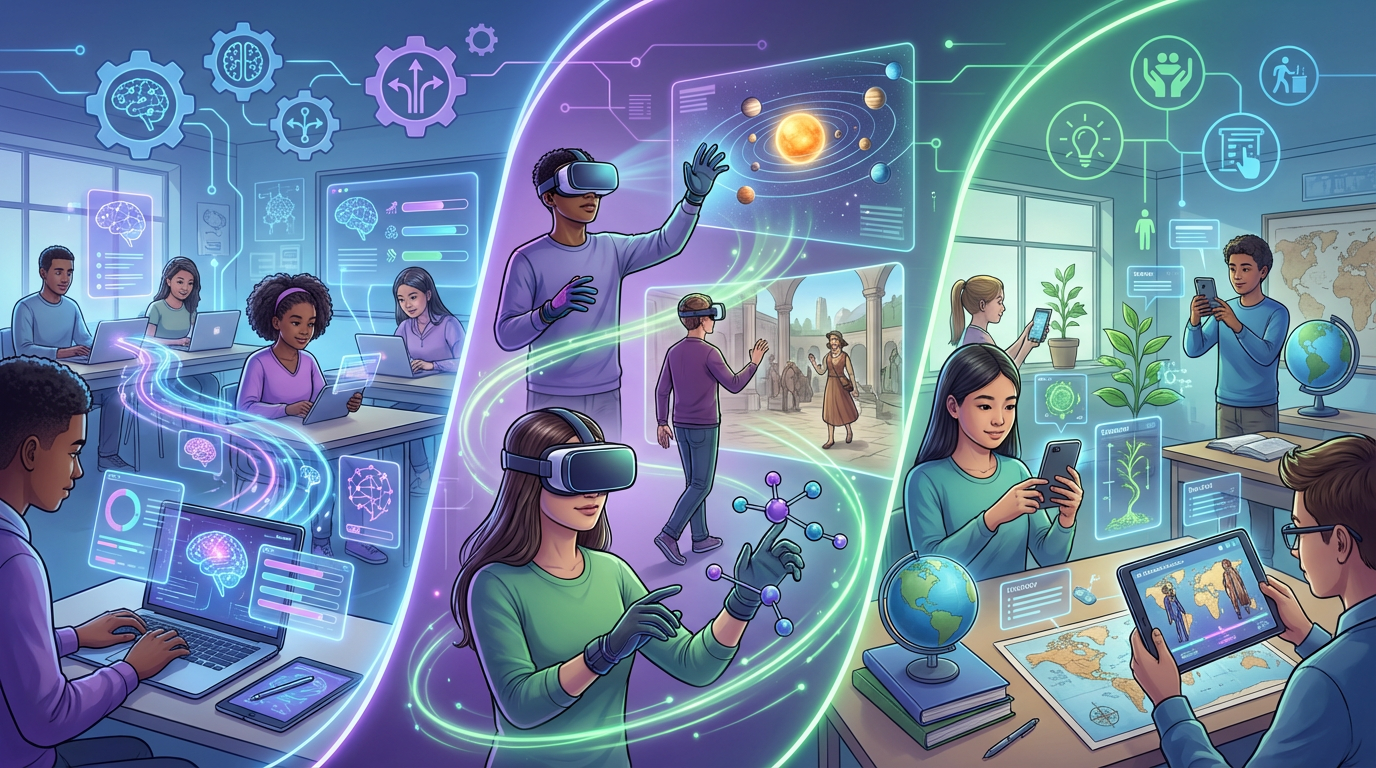
The quality and the way the content is being generated and delivered has been changing rapidly because of the rise of emerging technologies such as AI (Artificial Intelligence),AR (Augmented Reality), and VR (Virtual Reality). Many tools such as intelligent tutoring systems are also influencing the field of academics by helping in personalizing the assessments, and feedback systems. This has pushed me to think and learn about not just technical aspects but also the long term impacts they have on teaching, and learning. I also went back to my assignment I have done in another class (EDCI 338) on how digital communities support the learners to build their professional and personal digital identity.
Artificial Intelligence (AI)
AI in education serves various functions and some of them are supporting tutoring systems, assistance in writing and compartmentalization, and automated feedback. AI has the ability to evolve and change itself depending to the instructions and requirements to individual learners, which aligns with the ideas from Universal Design for Learning (UDL), by aligning to the notions of UDL, it encourages different pathways for engagement and understanding with different learners (CAST, 2018). With the help of AI, teachers can share their workload with AI, especially repetitive tasks and allow professors to engage themselves in more meaningful interactions with their students.
Virtual Reality (VR)
VR is known for its virtual immersive 3D world that simulates real-world or imaginary experiences. Many scholars think that VR can be linked to the learning of experimental theories, for example, Dewey believed that via active and meaningful experiences we can learn more effectively (Kolb, 2013). VR can be helpful in various ways such as enabling students to visit places that they can’t on their own, they can experience science simulations and complex topics as well.
Augmented Reality (AR)
Situated learning theory states that learning occurs very effectively when it happens in a context rich environment such as via social activity (Clancey, 1995). AR aligns very well with the situated learning theory because it overlays the digital information onto the real world using different types of devices such as phones and headsets, making the environment a activities rich environment. In terms of accessibility almost every student has phones on them which makes it very easy to implement.
By reflecting on what I learnt about the emerging technologies like AI, I can now understand that they are not just tools, but can be treated as a way of teaching. They very much influence the student’s reactions, how the teacher teaches, and also the communities in online space. Going forward I would use AI as a productive tool to achieve my set goals. I learnt that tools and technologies like these should help teaching to evolve not replace it.
Info: “I used AI tools to generate some of the images in this post, which helped me illustrate ideas more clearly while exploring the topic.”
References
Kelly, Orla & Buckley, Karen & Lieberman, Lauren & Arndt, Katrina. (2022). Universal Design for Learning – A framework for inclusion in Outdoor Learning. Journal of Outdoor and Environmental Education. 25. 1-15. 10.1007/s42322-022-00096-z.
Kolb, D. A. (2013). The process of experiential learning. In Culture and processes of adult learning (pp. 138-156). Routledge.
Clancey, William J. “A tutorial on situated learning.” Proceedings of the international conference on computers and education (Taiwan). 1995.